
Fixing Stamp Duty
Distortions, distortions, go away, don’t come back another day

Everyone who has ever thought about it knows that Britain’s Stamp Duty is a stupid tax. Rather than taxing property generally, it only taxes people when they move. This means people move less. Older people stay in houses that are too big for them, others don’t move for better-paying jobs, and having more children becomes more expensive. The result? A less mobile, less efficient housing market, and a slower economy.
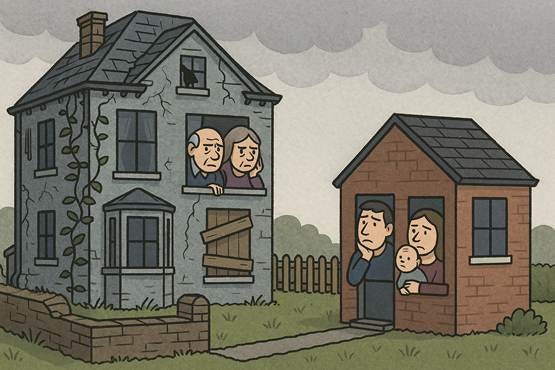
The government seems to agree that property taxation isn’t working in the UK. Everything appears to be on the table, from sharp tax hikes on those with more expensive properties, to more sophisticated reforms that will improve incentives and growth.
Tim Leunig’s excellent long report on property taxation in the UK points us in the right direction. His proposals for Stamp Duty are straightforward: get rid of it and replace it with an annual property value tax. To avoid taxing people twice, the new tax would only apply to those who buy a house after Stamp Duty has been abolished. He sets the rates so that in the long term, there is no net loss for the Treasury.
The problem is that, given the UK’s fiscal position, the Treasury has to live in the short term. It will take decades until the vast majority of UK housing stock is covered by the new tax. Leunig doesn’t give exact annual figures, but losses of around £9 billion in the first year and remaining at more than £6 billion a year after 5 years seem likely. While the losses would keep reducing each year, it would be decades before the Treasury breaks even within one fiscal year and then starts making back the lost revenue. Leunig recognises this and ultimately concludes that abolishing stamp duty in the short term is not going to be possible.
A more modest proposal
The Treasury won’t accept the short term hit to their balance sheet. The alternative of just bringing in the property tax straight away would go down in flames with the electorate. So, here’s my modest proposal.
Every property in the UK should be liable for Stamp Duty one last time and for the new property tax from the moment of sale. This sounds unfair on new buyers, but the Stamp Duty they pay should be allowed to offset the new property tax after they move in.
Let’s assume the Treasury calculates that the revenue-neutral introductory rate for the property tax is 0.2%. On a £250,000 property, you’d pay £2,500 in Stamp Duty, just as you would now. You’d also be liable for a £250-a-year property tax. However, since you’ve already paid £2,500 in Stamp Duty, you’d be able to offset your annual property tax against it, giving you ten years of relief. After that, you’d begin paying the tax annually.1
If you sell before using up your Stamp Duty credit, that credit is gone, for both you and the buyer. The new owner won’t need to pay stamp duty, but will begin paying the property tax from the day they move in. If the property you’re buying hasn’t had Stamp Duty paid on it since the new system began, you’ll pay Stamp Duty again and start the cycle over.
This is unfair on people who move frequently. But, and this is key, those people are already losing under the current system. They won’t be losing more under this proposal, and crucially, they’ll be the last generation who have to deal with this particular unfairness. Of course, this design also makes the transition more affordable for the Treasury.
Initially, the incentives of the new system will be similar to the current system. However, as more and more houses have had their last stamp duty paid, and fewer and fewer people are receiving the property tax credit, a greater number of homes will be stamp duty free and more and more people will be paying the new property tax. This will mean more and more people can upsize, downsize, move to a new area or make whatever decisions about housing are best for them, without making themselves liable for huge taxes.
A fiscally responsible way forward
Roughly 4% of British homes are sold each year. That means within 30 years, the vast majority of homes will have paid their last Stamp Duty and transitioned to the new tax. In the long term (when all homes are on the new property tax) and in the short term (when all sold homes are still paying Stamp Duty), the Treasury breaks even. The medium term is trickier: the Treasury still loses some revenue, though far less than under Leunig’s initial plan.
Why? Because homes that would’ve been sold multiple times, and thus paid Stamp Duty multiple times, will now only pay it once. And the large number of homes that won’t be sold for decades will not be paying the property tax. But there are politically palatable ways to make up the shortfall.
These include introducing the new property tax on second homes, rental properties, and expensive properties (e.g. £2.5 million or more) faster.2 In the case of second homes, there could be a two year grace period, while for rental properties the tax could be liable when tenancies change.
What about first-time buyers?
First time buyers currently pay lower Stamp Duty or none at all. This makes sense. The biggest barrier for first time buyers is saving for a deposit in the first place. Stamp Duty makes that even harder. To continue to help first-time-buyers, they should move straight to the new system as soon as they buy, with no upfront payment.
What about new builds?
There are two options for new builds
Keep stamp duty for new builds. As for buyers of other properties liable for stamp duty for the last time under the new system, new build buyers will get a property credit.
No upfront stamp duty on new builds from the start. This is simple, efficient, but will create an upfront revenue loss for the treasury.
I lean towards 2. Either would be preferable to the status quo.
Keeping it in the Family
Another complication is what to do about properties that are inherited and then lived in by the beneficiary. Under the current system, they don’t pay stamp duty. This is likely to mean some residences are not subject to the new property tax for decades or even hundreds of years, especially farms. Your view on what, if anything, the government should do about this will likely split on left/right lines. Options include:
Upon inheritance, the new owner starts paying property tax immediately. Why should someone who got a home for free be exempt from taxes everyone else has to pay?
Do nothing: there is no loss for the taxman here and why should the government get the right to tax the family farm?
Compromise: the new owner gets an exemption from property tax for a set period, recognising both that their circumstances are different to buyers while also bringing everyone into the same system eventually. They could also be given the ability to defer some of their property tax payments. This also avoids people being forced very quickly out of a home they have lived in with their deceased relative, but who can’t afford the taxes on it.
What will it mean for growth?
If adopted, Britain would end up with a much better tax system in the long run. But as Keynes observed: “In the long run, we’re all dead.”
Few politicians would attempt a complicated and risky reform to make the tax system more rational a decade from now. That’s a shame, but it’s unavoidable in a world where elections take place every five years.
Rachel Reeves needs growth now, not in a decade’s time. How can this new system help?
The best studies on Stamp Duty (and international equivalents) suggest that a 10% rate cut leads to a three to six percent increase in the moving rate – with move rates jumping more when coming from a high base.
If Reeves can recycle the revenue raised from immediately (or thereabouts) switching over second homes, mansions, and rental properties to cut the upfront charge, then she could see the benefits of a reformed property tax system much sooner.
I’ve not addressed whether this credit would be indexed to inflation. The answer to that will depend on Treasury calculations on revenue neutrality. What the treasury does about fiscal drag as property prices increase will probably depend on the state of the public finances year by year.
This isn’t very fair on owners of very expensive homes, second home owners, landlords nor ultimately their tenants who will bear at least some of the cost. However, the first three of those groups are not particularly popular and the public is not exactly well informed about how tax incidence works. Approving more ‘build to let’ development should reduce damage to the private rental market caused by this policy.